
Searching Cases by Name
For justice-court matters, the county's GovRec search separates criminal and civil searches for each of San Augustine County's four precincts. A criminal name search requires first name, last name, and date of birth. A civil individual search requires first and last name, while a business search uses the business name. Start with the court named on the citation or pleading. Picking the wrong precinct can yield no match even when a record exists.
District and county causes take a different path. Search re:SearchTX by party, attorney, judge, case description, or other available control, then filter by location and category. The live choices can change by release. An asterisk can serve as a wildcard for party and attorney names under the official quick-reference instructions.
- Identify the court level and likely filing year before opening a portal.
- Choose the correct GovRec precinct or the Cases area in re:SearchTX.
- Enter the exact required name fields and add a narrow court or category filter.
- Compare the court, filing date, party role, and cause number before opening a result.
| Field Label | Type | Required | Notes |
|---|---|---|---|
| First and Last Name | Text | Yes | Both are required for visible GovRec name modes. |
| Date of Birth | Date | Criminal only | Required for GovRec criminal name searches. |
| Business | Text | Business mode | Required when searching a civil business party. |
| Location and Category | Filters | No | Useful Advanced controls in re:SearchTX. |
San Augustine County Case Custodians
The case type controls who can confirm a San Augustine County search. Felony, district civil, family, probate, CPS, and Attorney General causes begin with the District Clerk. County-court criminal, probate, and mental-health files go to the County Clerk. Small claims, evictions, debt claims, and Class C justice matters belong with the proper justice clerk.
A City of San Augustine ordinance or municipal citation stays with Municipal Court at City Hall. Federal civil, criminal, and bankruptcy matters are separate and use PACER for the Lufkin Division. Sorting by court first prevents a local no-result screen from being mistaken for a countywide answer.
Searching by Case Number
An exact cause or case number is the strongest locator. Enter it as printed on the pleading, citation, notice, or prior order, including punctuation. San Augustine County has not published one universal local number pattern, so do not rebuild or guess missing characters. A known identifier such as cause number as filed should be paired with the court and approximate year when asking a clerk for help.
GovRec's inspected public configuration exposes citation search for justice criminal matters rather than a general case-number box. re:SearchTX includes case-oriented searches described in its guide. If either tool rejects the number, confirm whether it is a citation number, clerk cause number, or another agency's reference. Those numbers are not interchangeable.
San Augustine County GovRec Searches
San Augustine County GovRec is configured as eight applications: criminal and civil search for each justice precinct. Precinct 1 uses ORI TX203033J, Precinct 2 uses TX2030A3J, Precinct 3 uses TX203053J, and Precinct 4 uses TX203063J. These codes identify routes, not cases.
The official county-linked search screen may show case or citation number, a name, offense date or civil case type, status, amount due, and detail or payment controls. Closed matters were hidden by default in the inspected configuration. Captcha or loading trouble can also block a valid query.
The manifest capture of the GovRec San Augustine interface shows the portal used for these justice searches.
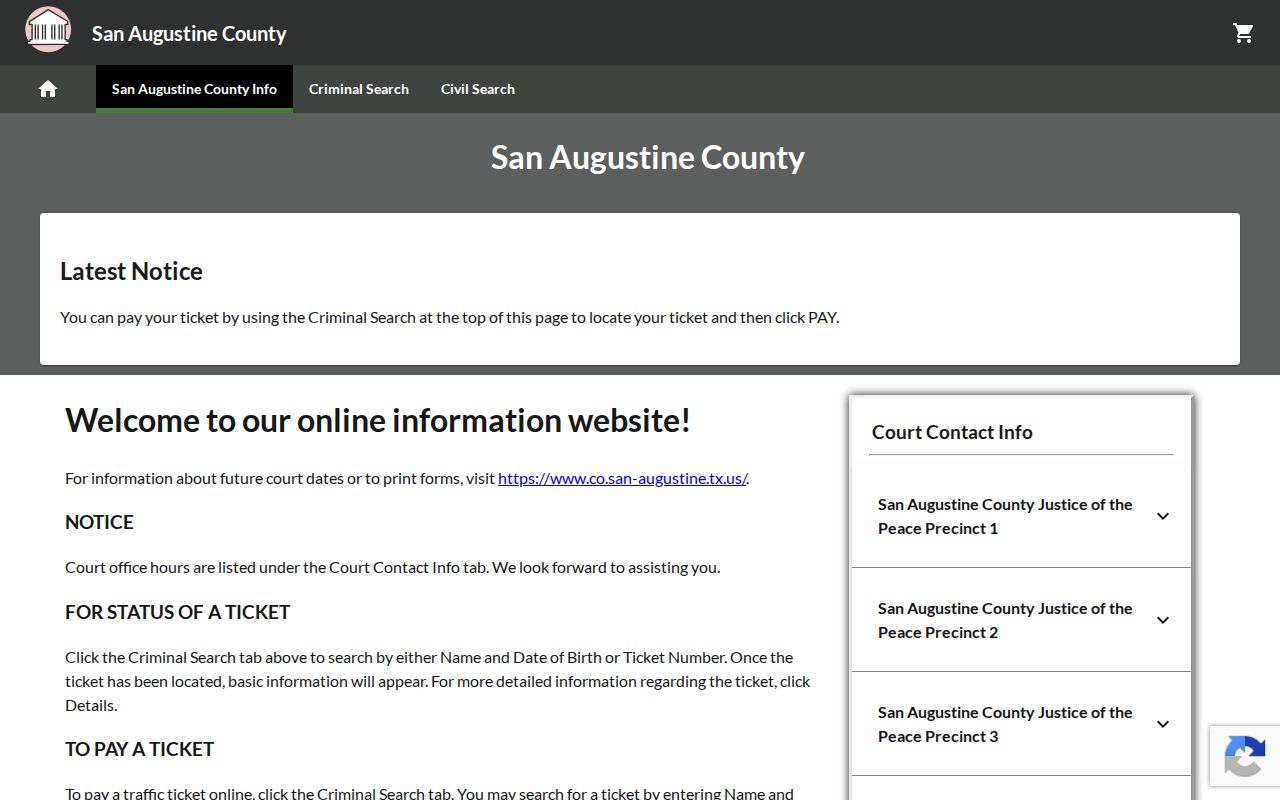
Its county-level landing page is a starting point, but the selected precinct and search mode decide what is actually queried.
What a Case Search Returns
A full San Augustine County register can carry a case header, style, court, category, filing date, parties and roles, attorneys, judge, chronological events, settings, orders, disposition, and post-judgment activity. GovRec is narrower and can emphasize payment and status. re:SearchTX case detail may include the register of actions, hearings, parties, attorneys, and links to available documents.
| Cause or Case Number | The clerk-assigned identifier used to locate the file. |
|---|---|
| Style and Roles | The caption plus plaintiff, defendant, petitioner, respondent, or State roles. |
| Case Category | Criminal, civil, family, probate, justice, or another displayed type. |
| Events and Hearings | Dated filings, orders, settings, and status changes. |
| Status or Disposition | Procedural posture, which should be checked against the signed order or judgment. |
San Augustine County Case Terms
Short labels make sense only in sequence. San Augustine County does not publish a local disposition-code book, so an abbreviation should be checked against the related order and confirmed with the clerk.
- Register of actions
- The dated list of filings, orders, hearings, and other case events.
- Setting
- A calendar placement for a hearing or other court event.
- Reset or continuance
- A move to a later date; the old entry may remain visible.
- Disposition
- The result of a claim, charge, or proceeding, not always shown in full by a status label.
- Certified copy
- A copy authenticated by the official custodian, unlike a portal download.
Statewide vs County Case Search
Texas Judicial Branch guidance says it does not maintain one statewide trial-court search covering every Texas case. re:SearchTX is an electronic statewide layer for participating district and county systems. GovRec is the clearest San Augustine County public path for justice cases. Neither replaces the clerk when coverage, access, or record completeness is in doubt.
| re:SearchTX | San Augustine GovRec |
|---|---|
| Participating district and county systems | Four San Augustine County justice precincts |
| Cases and Hearings areas with filters | Criminal citation/name and civil person/business modes |
| Best for an integrated district or county cause | Best for a known JP matter or citation |
When San Augustine Case Searches Fail
A blank result can mean the wrong precinct, a spelling mismatch, a closed case hidden by portal settings, a local system that has not integrated, or a lawful restriction. It does not prove that no case exists. First compare the court, year, category, and party role. Then retry with the exact cause number.
If access is blocked by a login, captcha, payment screen, or missing integration, use the fallback chain: court coordinator, District Clerk or County Clerk, the proper justice office, and then a precise written or in-person request. The El Camino Justice Center is the contact point for the four JP offices. There is no documented countywide public docket kiosk or general online request form.
San Augustine County Statewide Case Layer
The statewide search adds functions that GovRec does not. Its official guide separates Cases from Hearings, supports Advanced location and category filters, and allows sorting by newest filing date, oldest filing date, or case number. A result can be saved to a folder, exported, or paired with an optional alert when the current release permits it.
Case Notices are different from optional paid alerts. Texas began the present notice program in October 2025, but current guidance limits it mainly to attorneys of record in configured civil and family integrations. A missing notice is not proof that a San Augustine County case has no new event. Open the register and verify with the clerk.
Access and Restricted Cases
Public access depends on the record and court. Texas court access policy distinguishes adjudicative case files from ordinary agency records. Rule of Judicial Administration 12 addresses judicial records, while court and clerk rules govern case files. Civil records are presumptively open under Rule 76a, but sealing can follow a court order and required findings.
Juvenile, CPS, mental-health, adoption, certain protective-order, expunged, and sealed material can be absent, limited, or redacted. A result may show only a number or generic event. Ask the custodian whether a public redacted copy or docket-only view exists. Do not try to evade a restriction through another search route.
Online results are procedural references. Verify identity, party role, court, and the signed order before relying on a status. For the document behind an entry, the separate San Augustine County court records process explains clerk copies and certification.